
C R E A T I V E P R O C E S S
As I create Moving Works, I am deeply inspired by people and the stories we carry. I aspire to engage collective imaginations, varied abilities, personal experiences, and family histories.
My dance process seeks to reveal ways of moving the body that are atypical, working with a sense of theatricality that associates with images, environments, and intentions. A little bit of my own aesthetic dance history is important to talk about in order to understand how I have arrived at where my creative preferences are today.
In the early 2000’s at the UC Santa Barbara dance conservatory, while immersed in daily classical modern and ballet techniques, my affinity was for training with faculty and international guest artists who were focused on weaving “release” modern dance practices with contact improvisation. Release technique, at the time, encouraged the body to let go of classical aesthetics such as holding, shape making, and unnecessary muscular activation while propelling oneself through space into and around multiple dance partners.
My first jobs as a dance artist were in the lineage of dance theater in California, working with Santa Barbara Dance Theater and San Diego Dance Theater, among other companies, from 2006-2008. From there, I was professionally involved in the downtown Manhattan “movement research” circuit of choreographies from 2008-2017. (As a side note, around 2011-2012, my NYC colleagues and I started self identifying as “contemporary” dancers.)
As a “contemporary” dancer in NYC, I consistently performed “post-modern” dances at the Judson Church, St. Marks Church, Dance New Amsterdam, Joyce Soho, Dixon Place, and PS 122 for an array of directors. I practiced contact improvisation at the Children’s Aid Society off of Washington Square Park, Eden’s Expressway, and at 100 Grand for many years.
I was also a 4 year artist-in-residence at Center for Performance Research in Brooklyn. This residency provided me with an artistic home, a big open space to experiment with the dedicated dancers of Marcos Duran Performance Group. For those years, we worked together to open “the drawers of our minds,” to air out the corners of our psyches and tell our autobiographical stories through dance.
I relocated to San Diego in 2017 for a three year, improvisation based MFA dance teaching and performance program. With my teachers in Theater and Dance at UC San Diego, I gained the experience of directing productions not only with dancers and teams of designers, but also with composers, musicians, motion sensor engineers, actors, nanotechnologists, and visual artists. Here, my understanding of what dance could be expanded exponentially.
My MFA thesis production, The Underground, was a 95 minute visual dance fantasy inspired by the images of the 1934 “Une Semaine De Bonté: A Surrealistic Novel in Collage” by Max Ernst, and “My Body and I (Mon corps et moi),” the 1925 surrealist novel by queer, French writer René Crevel that explores the tension between the body and spirit.
Today, I call myself a dance theater / contemporary artist, and as a performer I have worked with somewhere between 50-100 choreographers over the last two decades. (I stopped counting at 50 about 10 years ago.)
My dance making process is influenced by my exposure to a seemingly endless amount of ways of generating choreography for rooftops, art galleries, public parks, churches, the concert stage, screen dance, and so many other places in between.
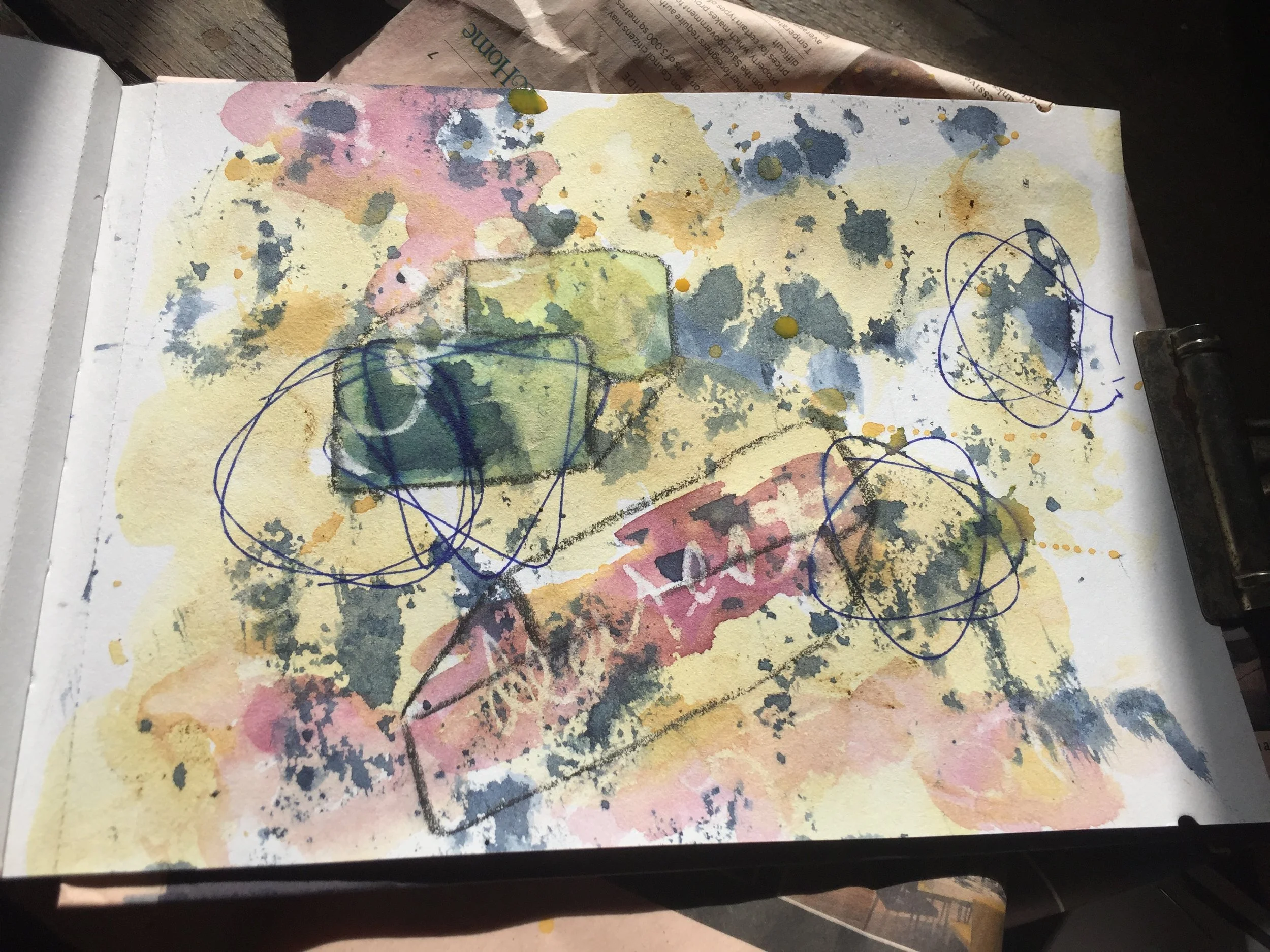
Each of my dance works uniquely excavates choreography from a matrix of sources. Writing, sketching, and watercolor help cultivate and externalize internal narratives and imagined worlds. Books, indigenous history, art history, cinema and music provide additional source materials.
Supplementally, I utilize my training in craniosacral therapy to enhance listening, body-to-body communication, and interdisciplinary collaboration. I draw from the durational sensibility I trained at the Marina Abramović Institute in Greece in 2024, in addition to implementing, to the best of my ability, equity minded leadership and compassionate communication. I trust and train dancers, collaborators, and our audiences to embody new ways of being together.
To cultivate sensitivity when facilitating intersectional groups, I always intend to honor and respect differences in physical ability, language ability, size, race, sexuality, religion, class, gender, family structure, and age. I hold talking circles where participants have opportunities to share their experiences and reflect. Creativity may be centered around storytelling, and all are encouraged to create performances that express the varied circumstances that make up their lives.